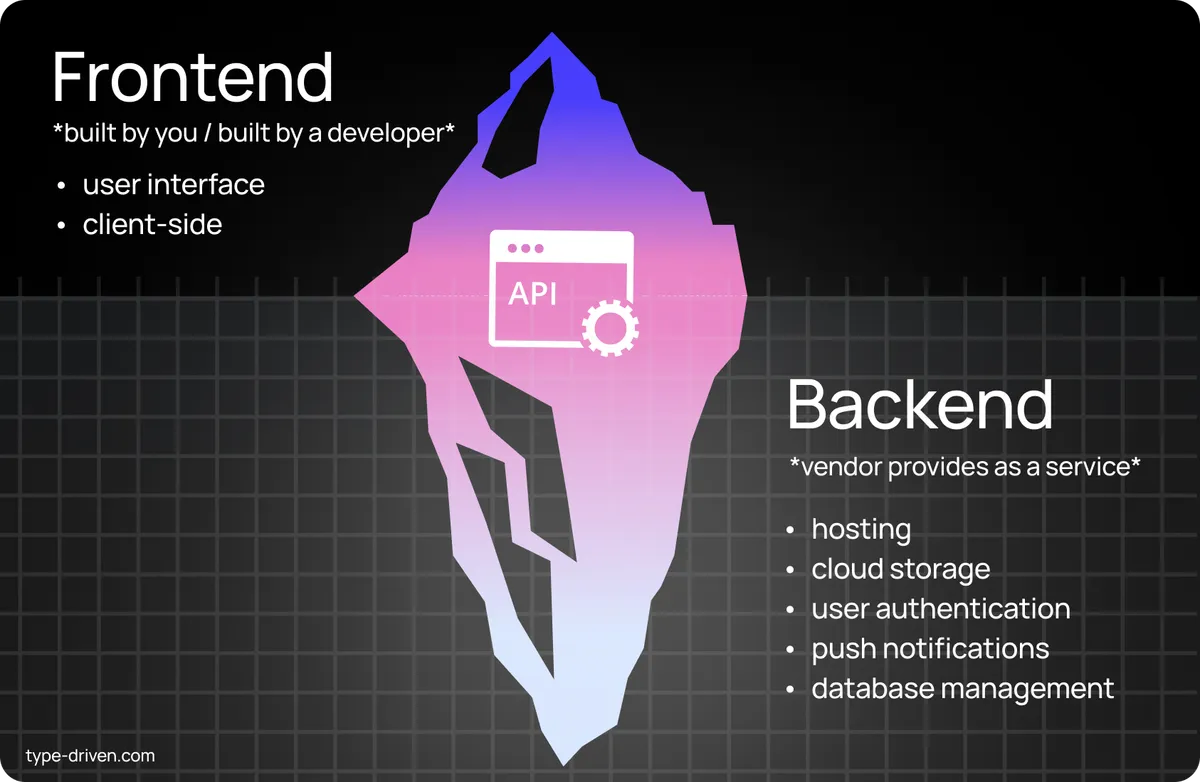
If you're building a web or mobile application, you've probably heard of Firebase, Supabase, or similar platforms. These are Backend-as-a-Service (BaaS) providers—and they've changed how teams ship products.
Let's break down what BaaS actually is, when it makes sense, and what to consider as your product grows.
What is Backend-as-a-Service?
Backend-as-a-Service (BaaS) is a cloud-based solution that provides ready-made backend functionality through APIs and SDKs. Instead of building and maintaining your own servers, databases, and authentication systems, you plug into a managed platform.
A typical BaaS platform provides:
- Authentication — User sign-up, login, social OAuth, password resets
- Database — Store and query data, often with real-time sync
- File Storage — Upload images, documents, videos with CDN delivery
- Serverless Functions — Run backend logic without managing servers
- Push Notifications — Send messages to mobile devices
The appeal is clear: you focus on building features while the platform handles infrastructure.
Popular BaaS Platforms
Firebase
Firebase is Google's comprehensive BaaS platform. It started as a real-time database and evolved into a full suite of tools.
Key features:
- Firestore (NoSQL document database)
- Real-time data synchronization
- Offline support with automatic sync
- Mature ecosystem with extensive documentation
- Tight integration with Google Cloud
Supabase
Supabase positions itself as an open-source Firebase alternative, built on PostgreSQL.
Key features:
- Full PostgreSQL database with SQL support
- Auto-generated REST and GraphQL APIs
- Row-Level Security for fine-grained permissions
- Open-source and self-hostable
- More predictable pricing model
Quick Comparison
| Aspect | Firebase | Supabase |
|---|---|---|
| Database | NoSQL (Firestore) | PostgreSQL (SQL) |
| Source | Proprietary | Open-source |
| Self-hosting | No | Yes |
| Pricing | Usage-based | Tiered |
| Best for | Real-time apps, mobile | SQL-heavy apps, data flexibility |
When BaaS Makes Sense
BaaS platforms shine in specific scenarios:
MVPs and Prototypes — When you need to validate an idea quickly, BaaS lets you ship in days instead of weeks. You can always rebuild later if the idea works.
Small Teams — If you don't have dedicated backend engineers, BaaS abstracts away the complexity of server management, security patches, and database administration.
Standard Use Cases — Apps with typical CRUD operations, user authentication, and file uploads fit perfectly into BaaS models.
Real-time Features — Both Firebase and Supabase excel at real-time data sync, making them ideal for chat apps, collaborative tools, or live dashboards.
According to Forrester Research, companies using BaaS solutions report 40-60% faster time-to-market for new features.
Just getting started? We help teams set up lean, efficient backends that get you to market fast—whether that's BaaS configuration or a lightweight custom setup tailored to your needs.
Get help with your backend setup →
What Happens When You Scale
Here's where things get interesting. BaaS platforms are optimized for getting started—but successful products often encounter friction as they grow.
Pricing at Scale
Firebase charges based on document reads, writes, and storage. What costs $25/month at 1,000 users might cost $2,500/month at 100,000 users. One viral feature can generate surprising bills.
Supabase offers more predictable tiered pricing, but heavy workloads still push you toward higher tiers quickly.
Customization Limits
BaaS platforms optimize for common patterns. When you need:
- Complex transactions across multiple data sources
- Custom caching strategies for performance
- Sophisticated rate limiting or throttling
- Multi-region data residency for compliance
- Deep observability and custom metrics
...you may find yourself working around the platform rather than with it.
Vendor Considerations
Your backend logic, data model, and authentication flow become intertwined with your chosen platform. If you later need to change direction, you're looking at:
- Rewriting serverless functions
- Migrating and potentially restructuring data
- Updating authentication flows across all clients
- Retraining your team on new patterns
This isn't necessarily a problem—but it's worth understanding before you start.
The Architecture Question
The real question isn't "Firebase or Supabase?" It's: what does success look like for your product, and what will you need then?
For many products, BaaS is the right choice forever. A content app with moderate traffic, a small SaaS tool, an internal business application—these may never need more than what BaaS provides.
But if you're building something designed to scale—something that will handle millions of requests, complex business logic, or strict compliance requirements—the architecture decisions you make early determine your options later.
A well-designed custom backend gives you:
- Type-safe error handling from database to API
- Composable services that scale independently
- Full observability with tracing and metrics you control
- Predictable costs because you understand your infrastructure
- Complete ownership of your code and data
Modern tools like Effect-TS make building robust, type-safe backends more accessible than ever—without sacrificing the developer experience that makes BaaS attractive.
Making the Decision
Choose BaaS when:
- Speed to market is critical
- Your use case fits standard patterns
- You have limited backend expertise
- You're validating an idea
Consider custom architecture when:
- You have complex business logic
- Compliance or data residency matters
- You need fine-grained control over performance
- You're building for significant scale
There's no wrong answer—only trade-offs. The key is making an informed decision based on where you're going, not just where you are today.
Outgrowing your current setup? If you're running a successful product that's hitting the limits of BaaS—or you're feeling the pain of scaling—we help teams design and build backend architectures that grow with you. Type-safe, observable, and built to last.