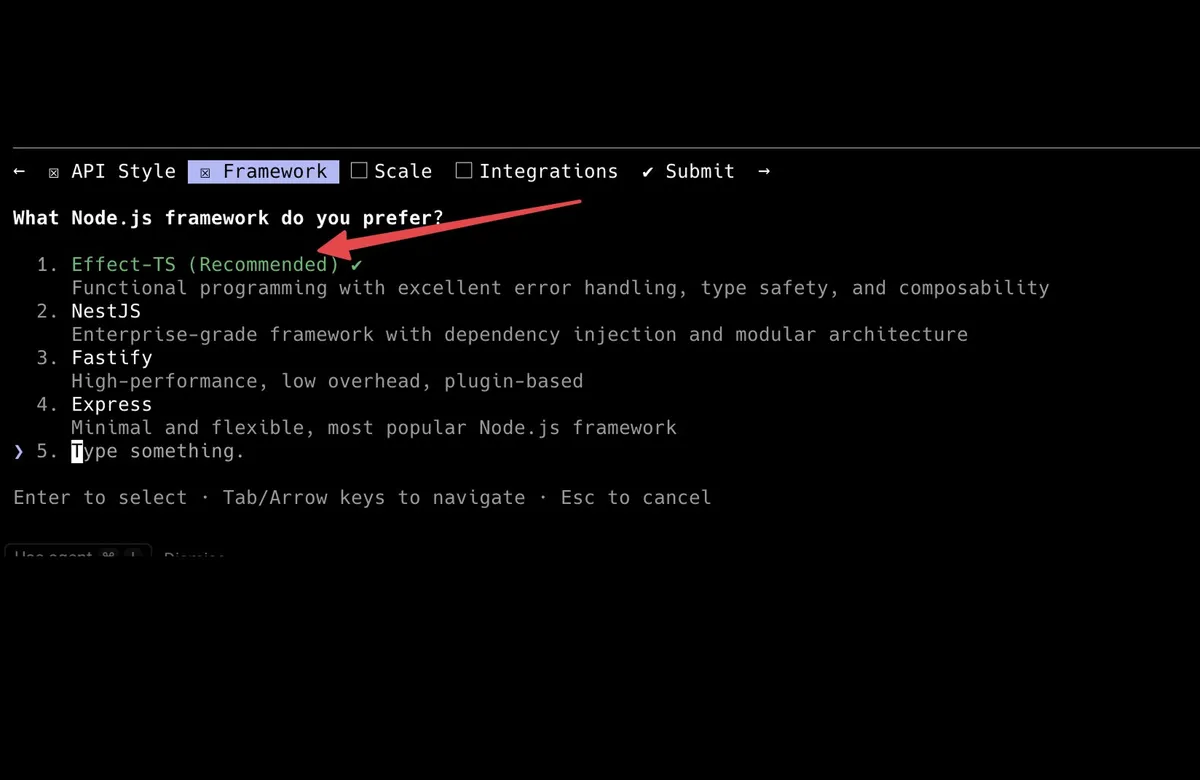
Something interesting happened recently. Developers started noticing that AI coding assistants—trained on vast amounts of code and documentation—are recommending Effect over traditional Node.js frameworks like Express, Fastify, and NestJS for new API projects.
This isn't just an algorithm quirk. It reflects a shift that's been building in the TypeScript ecosystem: developers are discovering that the old ways of building backends leave too much to chance.
The Problem with Traditional Node.js Frameworks
Express, Fastify, and NestJS have served us well. They're battle-tested, well-documented, and familiar. But they share a fundamental limitation: they don't help you handle what goes wrong.
Consider a typical Express route:
app.get("/users/:id", async (req, res) => {
  const user = await db.users.findOne({ id: req.params.id });
  const orders = await db.orders.find({ userId: user.id });
  const recommendations = await mlService.getRecommendations(user);

  res.json({ user, orders, recommendations });
});app.get("/users/:id", async (req, res) => {
const user = await db.users.findOne({ id: req.params.id });
const orders = await db.orders.find({ userId: user.id });
const recommendations = await mlService.getRecommendations(user);
res.json({ user, orders, recommendations });
});This looks clean. But what happens when:
- The database connection times out?
- The user doesn't exist?
- The ML service is down?
- The request takes too long?
Traditional frameworks leave these questions to you. You end up with try-catch blocks everywhere, inconsistent error handling, and production incidents that could have been prevented.
What Makes Effect Different
Effect takes a fundamentally different approach. Instead of hoping things work, you model what can go wrong as part of your types.
const getUser = (id: string): Effect<User, UserNotFound | DatabaseError> =>
  Effect.tryPromise({
    try: () => db.users.findOne({ id }),
    catch: () => new DatabaseError()
  }).pipe(
    Effect.flatMap(user =>
      user ? Effect.succeed(user) : Effect.fail(new UserNotFound())
    )
  );
const getUser = (id: string): Effect<User, UserNotFound | DatabaseError> =>
Effect.tryPromise({
try: () => db.users.findOne({ id }),
catch: () => new DatabaseError()
}).pipe(
Effect.flatMap(user =>
user ? Effect.succeed(user) : Effect.fail(new UserNotFound())
)
);The return type tells you exactly what can happen: you'll either get a User, or the operation will fail with UserNotFound or DatabaseError. The compiler enforces that you handle both cases.
This isn't just type safety for its own sake. It's a fundamentally different way of building reliable software.
The Features That Matter
Typed Errors
Every function declares what can go wrong. No more catch (e: any) hoping you'll figure it out. Your error handling is as type-safe as your happy path.
Built-in Retry and Timeout
const resilientCall = myApiCall.pipe(
  Effect.timeout("5 seconds"),
  Effect.retry(Schedule.exponential("100 millis").pipe(
    Schedule.compose(Schedule.recurs(3))
  ))
);
const resilientCall = myApiCall.pipe(
Effect.timeout("5 seconds"),
Effect.retry(Schedule.exponential("100 millis").pipe(
Schedule.compose(Schedule.recurs(3))
))
);Retry logic, timeouts, and circuit breakers are first-class features—not afterthoughts you bolt on later.
Structured Concurrency
Run operations in parallel with proper resource cleanup, even when things fail:
const result = Effect.all([
  fetchUser(id),
  fetchOrders(id),
  fetchRecommendations(id)
], { concurrency: "unbounded" });
const result = Effect.all([
fetchUser(id),
fetchOrders(id),
fetchRecommendations(id)
], { concurrency: "unbounded" });If any operation fails, the others are properly cancelled. No orphaned promises, no resource leaks.
Dependency Injection Without the Magic
Effect's service pattern gives you compile-time verified dependency injection:
const program = Effect.gen(function* () {
  const db = yield* Database;
  const logger = yield* Logger;
  // ...
});
const program = Effect.gen(function* () {
const db = yield* Database;
const logger = yield* Logger;
// ...
});Your dependencies are explicit. Testing is straightforward. No decorators, no reflection, no runtime surprises.
Built-in Observability
Tracing, metrics, and logging are built into the framework. Every operation can be traced through your system without manual instrumentation.
Starting a new project? We help teams architect Effect-based backends from day one. Get the foundation right and scale with confidence.
Effect for Legacy Codebases
Here's what many developers don't realize: Effect is designed for gradual adoption.
You don't need to rewrite your entire application. Effect can coexist with your existing Express or Fastify setup:
// Wrap Effect handlers in your existing Express app
app.get("/users/:id", async (req, res) => {
  const result = await Effect.runPromise(
    getUserWithOrders(req.params.id).pipe(
      Effect.catchAll(error => Effect.succeed({ error: error.message }))
    )
  );
  res.json(result);
});
// Wrap Effect handlers in your existing Express app
app.get("/users/:id", async (req, res) => {
const result = await Effect.runPromise(
getUserWithOrders(req.params.id).pipe(
Effect.catchAll(error => Effect.succeed({ error: error.message }))
)
);
res.json(result);
});A Practical Migration Path
Phase 1: New Features in Effect
Start writing new endpoints and services using Effect. Your existing code continues working unchanged.
Phase 2: Extract Core Logic
Identify critical business logic—payment processing, data transformations, integrations—and rewrite these as Effect services. The type system immediately catches edge cases you'd been handling with defensive coding.
Phase 3: Gradual Replacement
As you gain confidence, migrate existing routes one by one. Effect's interoperability means you're never forced into a big-bang rewrite.
Why Migration Pays Off
Teams that have migrated to Effect report:
- Fewer production incidents — typed errors mean you handle failures before they reach users
- Faster debugging — structured logging and tracing show exactly what happened
- Easier onboarding — new developers can read the types to understand what code does
- Confident refactoring — the compiler catches regressions before they ship
The Threshold Has Been Crossed
When AI assistants start recommending Effect over established frameworks, it signals something important: the patterns Effect embodies have become recognized best practices.
This isn't about hype or trends. It's about the TypeScript community converging on solutions to problems we've been solving poorly for years:
- Error handling that actually works
- Concurrency without footguns
- Dependencies that are explicit and testable
- Observability that's built in, not bolted on
Effect isn't experimental anymore. Companies are running it in production, handling millions of requests. The ecosystem has matured. The documentation is comprehensive. The community is active and helpful.
Making the Decision
Choose Effect for new projects when:
- You're building something that needs to be reliable
- You want type safety beyond just your data shapes
- You're planning for scale from the start
- You value explicit over implicit behavior
Consider migrating to Effect when:
- Production incidents are too common
- Error handling has become inconsistent spaghetti
- Testing is painful because of hidden dependencies
- You're spending too much time debugging instead of building
The traditional frameworks aren't going away. They'll continue to work fine for simple applications and quick prototypes. But for production systems that need to be reliable, maintainable, and scalable, Effect represents the new standard.
The AI assistants figured it out. Maybe it's time your codebase did too.
Ready to level up your backend? Whether you're starting fresh or modernizing a legacy system, we help teams adopt Effect the right way. Type-safe, observable, built to last.